Discover the Timeless Appeal of Checkers
Origins and enduring popularity
Checkers is one of the oldest known board games, with roots that stretch back to ancient civilizations. Over centuries the game has travelled across continents, adapting to local cultures while retaining its essential simplicity. Today it remains a staple in homes, schools and online gaming platforms, offering a familiar yet challenging experience for players of every age.
Core experience for modern players
The allure of Checkers lies in its elegant balance of easy to learn rules and deep strategic possibilities. A new player can grasp the basic moves within minutes, yet mastering the art of forced jumps and king positioning can take a lifetime of practice. This combination makes Checkers an ideal choice for quick casual sessions as well as serious competitive play.
What makes Checkers stand out
Simple rules with deep strategy
- Each piece moves diagonally on dark squares, eliminating the need for complex movement patterns.
- Capturing is mandatory, which creates constant tactical tension and forces players to think ahead.
- The promotion to king adds a layer of long‑term planning, as kings gain the ability to move backward.
Quick games that fit any schedule
- A typical match lasts between five and fifteen minutes, allowing players to enjoy multiple rounds in a short period.
- The compact board size makes the game portable and suitable for play on physical tables or digital screens.
- Because the rules are universal, players can start a game with strangers without needing extensive explanations.
How to play
Setting up the board
- Place the board so each player has a dark square in the near left corner.
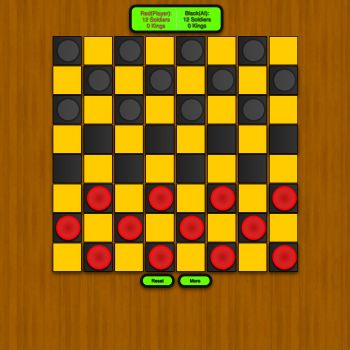
- Each player receives twelve pieces placed on the dark squares of the three rows closest to them.
Basic movement and captures
- Pieces move diagonally forward one square onto an empty dark square.
- If an opponent piece occupies a diagonal adjacent square and the square beyond it is empty, the player may jump over and remove the opponent piece.
- Multiple jumps are allowed in a single turn when the landing position creates another capture opportunity.
Advancing to king status
- When a piece reaches the farthest row from its starting position it is crowned and becomes a king.
- Kings may move diagonally forward and backward one square, greatly expanding their mobility.
- Kings also retain the ability to make multiple jumps in any diagonal direction.
Winning the match
- The game ends when a player captures all opponent pieces or blocks all possible moves.
- If neither player can force a capture and the board reaches a stalemate, the match may be declared a draw.
Strategies to improve your game
Control the center of the board
Dominating the central dark squares gives a player more options for both offensive jumps and defensive retreats. By occupying these key positions early, you limit the opponent’s ability to create forced captures and increase the likelihood of advancing your own pieces to king status.
Plan multiple jumps in advance
Because captures are mandatory, a skilled player will look several moves ahead to set up chains of jumps. Visualizing potential routes for a piece to leap over several opponent pieces can turn a seemingly ordinary move into a decisive swing.
Balance aggression with safety
While it is tempting to launch an immediate attack, reckless advances can leave your pieces vulnerable to counter‑jumps. Maintaining a solid defensive line while probing for weaknesses often yields better long‑term results.
Use kings wisely
Kings are powerful but can become overextended if used without caution. Keep your kings near the center where they can influence both sides of the board, and avoid placing them on the edge where they have limited movement options.
Frequently asked questions
Can a piece move backward before it becomes a king?
No a piece may only move forward until it is crowned as a king.
Is it possible to force a draw?
Yes if both players repeat the same position three times the game is declared a draw.
Do different board sizes exist for Checkers?
The standard game uses an eight by eight board but variations such as international draughts use a ten by ten board.
How many pieces does each player start with?
Each player begins with twelve pieces placed on the dark squares of the three rows closest to them.
What is the main difference between a regular piece and a king?
A regular piece moves only forward diagonally while a king can move both forward and backward diagonally.